

Video Game Throwback: Ayrton Senna’s Super Monaco GP II - Authentic F1


A lot of video game racing fans will remember this title fondly. Well, those of us old enough at least.
It was one of the first games to truly capture Formula One into a digital format. For its time, Ayrton Senna’s Super Monaco GP II was a very authentic game. There was a 16-race world championship circuit with real racetracks. It included qualifying (preliminary race), multiple teams with various levels of skill, rivalries, pit stops, and even weather.
Launched in 1992, as the title suggests, it was developed with the help of the 1991 F1 champion Ayrton Senna. It wasn’t just a branding exercise either, as Senna actually made suggestions to give the game a better sense of speed and realism compared to the original Super Monaco GP game.

Senna was also included in the game. He was the main adversary in the World Championship mode, and his voice could be heard throughout the game shouting phrases at the player like Keep it Up, C’mon, and Final Lap. If sporadic sound clips weren’t enough, players did have the ability to go into the options screen and scroll through these words, having Senna say them over and over. It was like a bad remix of a Speak and Spell.
Like Real F1

There were three main game modes. Free Practice, World Championship, and Senna GP. The latter involved three Senna-designed fantasy racecourses that players could test their skills on. But the real meat and potatoes of the game was the World Championship.
It included 16 races at various real-life tracks throughout the world. As has always been the case with F1, not all cars were created equal. The game featured sixteen teams, each running one car. The teams were separated into tiers, with D being the lowest, then C, B, and A. The highest tier was S, which included just one team, MADONNA. This was the car driven by Ayrton Senna.

Each team had full specifications on their car; its engine, power, handling, tires, aero, etc. Much like Grand Theft Auto, the names used for the teams, engines, and chassis were all made-up names, but mimicked real-world ones.
Rival Your Way Up

Players began the season on a low-tier C team. Before each race, there was the option to pick a rival to race. The Player could pick any rival in the game, but because of the performance disparity in the game, it was best to start by picking a car from the B tier.
During the race there was always a display indicating the player’s racing position as well as the rival’s racing position. If the player beat their rival a few times, the rival’s team would offer the player to join their team instead. So, by rivalling better teams, and winning, it was possible to be on a tier A team by mid-season.

Getting on better teams meant having faster cars, but it also meant the lower-tier teams would rival the player from time to time. Lose too many of these races and the player gets demoted to a worse team. I remember sucking so bad at this game that a few races into a championship, I would be racing in the D tier.
Hard to Master
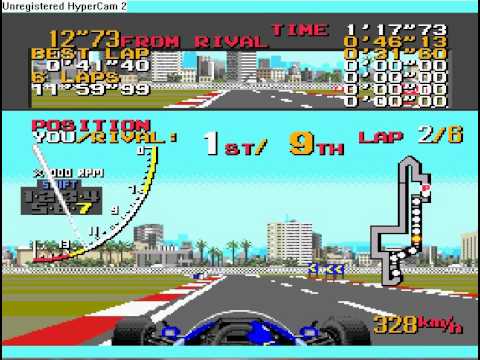
The gameplay was fast-paced and required quick reactions. It elevated the usual stationary car, rolling track racing game style that was still popular at the time. Although the sensation of the car moving instead of the track was still missing, the player did feel more in control of their car.
Braking wasn’t required for the majority of the courses, as only the tightest of corners required a stab of the braking button. If using the full seven-speed manual transmission mode, downshifts sounded quite cool and realistic. All other car sound effects were less than stellar, with the player’s car sounding like a vacuum while opponents' cars sounded like a swarm of angry bees.

Regardless of how good a player was, a bit of fun could be had at the finish as the guy waving the checkered flag would be standing on the track. If timed right, it was possible to punt this digitized guy way off into the horizon.
If one did learn to master this game and win the World Championship, Senna’s digitized self would come up in the paddock and raise the player’s hand in victory. There would then be a screen with his picture and scrolling text congratulating the player and how they would dominate F1 for years to come. It was a cool end to an authentic-for-its-time game, but it would take on new meaning and somberness just a few years later.
Become an AutoGuide insider. Get the latest from the automotive world first by subscribing to our newsletter here.
A 20+ year industry veteran, Mike rejoins the AutoGuide team as the Managing Editor. He started his career at a young age working at dealerships, car rentals, and used car advertisers. He then found his true passion, automotive writing. After contributing to multiple websites for several years, he spent the next six years working at the head office of an automotive OEM, before returning back to the field he loves. He is a member of the Automobile Journalists Association of Canada (AJAC), and Midwest Automotive Media Association (MAMA). He's the recipient of a feature writing of the year award and multiple video of the year awards.
More by Mike Schlee


Comments
Join the conversation
Nice! Love the vintage videogame related content.