


EPA Ends Credits for 'Universally Hated' Auto-Stop/Start Systems

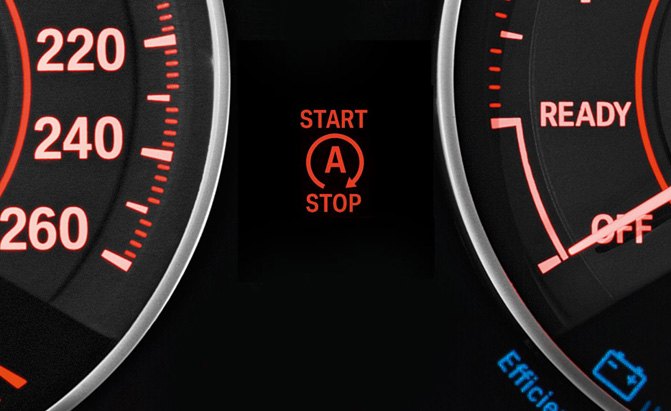
Divisive? Yes. Saves fuel? Yes. Universally hated? Hmmm...
As part of the Environmental Protection Agency's sweeping reforms to limit its own abilities to regulate gas emissions, EPA head Lee Zeldin on Thursday announced that the agency would phase out federal automaker credits for stop-start systems.
If there's a modern automotive feature that has proven most divisive, it's the automatic stop-start system. Proliferating across automakers' lineups over the past two decades, the system is pretty simple in concept: when the car is stopped, the engine shuts off, quickly restarting when the driver either takes their foot off the brake or engages the clutch.

The benefits of stop-start systems are numerous, though often challenged. Early systems required specialized batteries, which could increase replacement costs. A large part of the equation is how drivers use their cars, too: someone doing mostly highway miles, with little time for stopping, will see little if any benefit, while city dwellers could see huge savings. The majority of new vehicles sold in the US use some version of a stop-start system.
Zeldin took aim at stop-start systems last year, calling them " climate participation trophies." He also described the system as one where "your car dies at every red light." He also promised to quite literally fix what isn't broken. These systems initially spread across the US auto industry as a way for automakers to earn credits that they could then use against any Corporate Average Fuel Economy (CAFE) standard fines. Since those penalties were also eliminated by the Trump administration last year, automakers could (in theory) start removing said systems.
Auto stop-start has improved over the years. Early systems could be jerky and slow, and initially automakers only received maximum credits if the system was permanently active. That was soon changed to give drivers the ability to turn the system off—something, Zeldin should be told, is still very much possible—with modern hybrids smoothing out the process substantially. Even mild hybrids, which typically use an integrated starter generator (ISG) in place of a regular starter, make stop-start systems a painless experience.
Nowadays, the savings at the pumps can be even better. In a 2023 study, the Society of Automotive Engineers (SAE) found modern stop-start systems can save between 7.27 to 26.4 percent of fuel. And again; almost all modern vehicles with such systems allow drivers to deactivate them.

Our Take:
Look, it sounds like Lee Zeldin just maybe never experienced a good stop-start system. "Universally hated" is the sort of emotional, fact-free wording the EPA should be avoiding, but then again, this is the latest move in a long line of partisan actions. While we don't expect many automakers to remove such systems, especially as many are tied to some level of electrification, the message is clear: Mr. Zeldin would like you to buy more gas.
Become an AutoGuide insider. Get the latest from the automotive world first by subscribing to our newsletter here.
Kyle began his automotive obsession before he even started school, courtesy of a remote control Porsche and various LEGO sets. He later studied advertising and graphic design at Humber College, which led him to writing about cars (both real and digital). He is now a proud member of the Automobile Journalists Association of Canada (AJAC), where he was the Journalist of the Year runner-up for 2021.
More by Kyle Patrick





Comments
Join the conversation
"...That was soon changed to give drivers the ability to turn the system off—something, Zeldin should be told, is still very much possible..."
It is not possible to turn the system off in ALL new vehicles. I considered buying a 2025 Volvo XC40. As soon as the salesperson told me that the Stop/Start could not be switched off under any circumstance, I was out of there.
I have a 2025 Volvo XC60 and the start/stop system is the best one I have experienced yet. The vehicle is a mild hybrid and has a starter/generator and is almost invisible. I generally do not like these systems, but can live with this one and not hate it.