

Volvo CEO Says There's 'No Turning Back' From an Electric Car Market


Volvo's Hakan Samuelsson believes an all-electric automotive landscape is only a matter of time.
Almost exactly one year ago, Volvo walked back its original goal of 100-percent electric models by 2030. The revised plan is now 90-percent electrification, rolling in hybrids and plug-in hybrids. Yet according to the Swedish brand's current CEO Hakan Samuelsson, the end result will still be a fully electric new-car landscape—it just might take longer in some parts of the world.
"The industry will be electric—there’s no turning back," Samuelsson told Bloomberg (subscription required). "It may take a bit longer in some regions, but the direction is clear. In (about) 10 years, cars will all be electric and they will be lower cost."
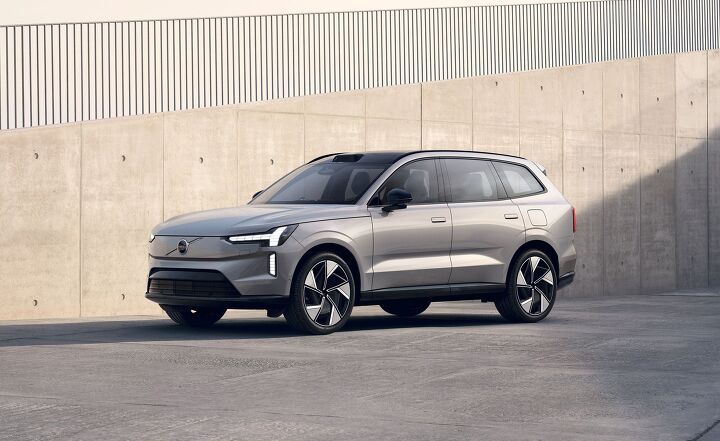
Certainly, Volvo, which is owned by Chinese conglomerate Geely, is still heading down that road. The all-electric EX90 flagship SUV arrived a year ago and is now built in America; the ES90 has entered production and the EX60 will debut in the new year. Once that happens, Volvo will have electric variants of all its major models, along with the pint-sized EX30. Yet the brand's global EV sales have fallen so far in 2024, and in fact so have overall sales by 10 percent. No doubt the uncertainty over tariffs and the anti-electric stance of the current administration hasn't helped in America.
Samuelsson also predicts that not every automaker will survive the electric transition. The exec expects some companies to "adapt to new circumstances and survive," but not all. Perhaps least surprising given Volvo's parent company, Samuelsson suspects "two or three very strong Chinese brands" will be part of this new landscape.
Needless to say, it's a bold prediction in the face of ever-increasing uncertainty over electric car adoption. Mercedes-Benz CEO Ola Källenius and Schaeffler AG Matthias Zink sent a joint letter to European Commission President Ursula von der Leyen calling the 2030 and 2035 emissions targets " no longer feasible." Various automaker representatives will be meeting with von der Leyen tomorrow to discuss the legislation.
Become an AutoGuide insider. Get the latest from the automotive world first by subscribing to our newsletter here.
Kyle began his automotive obsession before he even started school, courtesy of a remote control Porsche and various LEGO sets. He later studied advertising and graphic design at Humber College, which led him to writing about cars (both real and digital). He is now a proud member of the Automobile Journalists Association of Canada (AJAC), where he was the Journalist of the Year runner-up for 2021.
More by Kyle Patrick




Comments
Join the conversation
This CEO reveals his lack of understanding of much of the US vehicle market. Without some new tech, there are vast areas where charging infrastructure will never be cost-effective nor 'environmentally friendly' (carbon/environmental footprint of building/maintaining such infrastructure in remote locations for minimal use vs those in urban areas). Efficient ICE (either alone or in hybrids) will continue to be an important part of the market for the foreseeable future.
Until EVs have a minimum charge range of 400 miles with charging stations available on every corner of arterial intersections, EVs will be limited only to urban applications. Eventually, as SMR nuclear generated electricity becomes commonplace and battery technology approaches its full potential, EVs could replace ICE in thirty years ......maybe. It's entirely up to unfettered market forces to determine how fast this will come to pass. One must consider that fossil fuelers are also evolving. Loading EVs with nonessential bloat to compete with equally bloated ICE serves to retard the adoption of EVs for sake of economy and simplicity.