

IIHS Blames Advertising For America's Speed Problem

The Insurance Institute for Highway Safety says American car advertising has a speed problem.
A new IIHS study examining vehicle advertisements aired between 2018 and 2022 found that 43 percent focused heavily on themes like speed, acceleration, maneuverability, power, traction, or aggressive driving capability. Safety, meanwhile, barely registered by comparison. According to the organization, performance-related messaging appeared more than twice as often as safety-focused content in both television and online ads.

Vehicles are faster than ever. Pickups now accelerate like old Corvettes. Family SUVs routinely produce 300 horsepower or more without anyone even blinking anymore. Yet American roads also continue dealing with a worsening speeding problem that contributed to more than 11,000 traffic deaths in 2024 alone, accounting for roughly 29 percent of all roadway fatalities nationwide.
The IIHS believes advertising culture plays at least some role in shaping that behavior.
“Showing a stunt driver zooming around a tight turn in the rain might seem harmless, but these ads reinforce our cultural obsession with speed,” said IIHS president David Harkey. “The fine print may caution that it’s a professional driver on a closed course, but the message they convey is that you can drive this way too.”
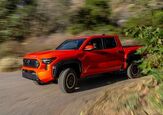
Modern automotive marketing often walks a strange line. Commercials rarely show the realities of daily commuting because nobody wants to watch a crossover trapped behind a landscaping trailer. Instead, automakers sell fantasy. Trucks launch across muddy trails. SUVs climb mountains most owners will never visit. Sedans carve canyon roads at speeds that would immediately earn someone a suspended license in real life.

The IIHS study noted that traction-related imagery became increasingly common during the study period, rising from 20 percent of ads in 2018 to 38 percent by 2022. Speed-focused themes also increased, while safety messaging dropped sharply from 11 percent to just 3 percent during the same timeframe.
Pickup trucks appeared most frequently in performance-oriented advertising overall, though sedans were most commonly associated specifically with speeding imagery.
Interestingly, the organization points out that the U.S. has relatively loose advertising oversight compared with other countries. In the United Kingdom, for example, advertisements emphasizing acceleration, power, or handling are heavily restricted unless framed within a safety context. In America, broadcasters largely self-regulate those standards instead.

The rise of muscle cars in the 1960s wasn’t driven solely by engineering; advertising sold the entire identity surrounding them. Same story later with SUVs in the 1990s and off-road trucks in the 2000s. Commercials helped convince suburban commuters that they urgently needed locking differentials and 35-inch tires to survive grocery-store parking lots.
The IIHS referenced Nissan’s controversial 1990 Super Bowl commercial for the 300ZX Turbo, which faced backlash from safety advocates for glamorizing high-speed driving. Nissan eventually agreed not to air it again.
But today’s ads arguably blur the line even further because modern vehicles are substantially more capable than the machines from those earlier eras. A 700-horsepower pickup used to sound absurd. Now it’s an option package.
“The vast majority of viewers are never going to take their vehicle through a mountain stream or up a sand dune,” said IIHS research scientist Amber Woods. “But this kind of ad could influence the way they drive in risky on-road conditions.”
Automotive enthusiasm has always been intertwined with speed, performance, and capability. Nobody buys a Mustang Dark Horse or a Corvette because they enjoy obeying merging speeds. Car culture without performance becomes pretty sterile pretty quickly.
The IIHS isn’t calling for the death of performance cars or truck advertising altogether. The organization simply argues automakers and broadcasters should treat reckless-speed messaging with the same caution applied to drunk driving or seat belt usage.
Whether regulators eventually step in remains unclear. But the study does tap into a broader shift happening throughout the industry right now, where conversations around vehicle capability are increasingly colliding with questions about public safety, driver behavior, and responsibility.
Become an AutoGuide insider. Get the latest from the automotive world first by subscribing to our newsletter here.

More by Avery Anderson





Comments
Join the conversation
Step up enforcement and prosecution! Since it's a choice, like drunk driving, a danger to everyone on the road, like drunk driving and kills nearly as many people as drunk driving prosecute it like drunk driving. Let the irresponsible spend a night in jail, spend thousands of dollars defending themselves in court, lose their licenses, and maybe their jobs. Send habitual offenders to prison! Remember, someone killed by a speeder is just as dead as someone killed by a drunk!
Drivers are the problem