

Nissan Murano vs Toyota Crown Signia Comparison


Co-Written with Mike Schlee
It’s plucky upstart against the segment veteran.
Late last year we held one of our mega comparisons. Except, uh, it wasn’t so mega. Due to a variety of factors we only actually got four vehicles together, and at the end of that four-way face-off, it was the Toyota Crown Signia that emerged victorious.
WATCH THE FULL VIDEO HERE
But one of the missing suspects arguably kicked off this semi-premium, slightly-larger two-row SUV segment: the Nissan Murano. After a long, long time, Nissan’s style-focused SUV has a new generation, with a new look, new engine, and new transmission. Can the Crown Signia beat the originator? Let’s find out.
Style
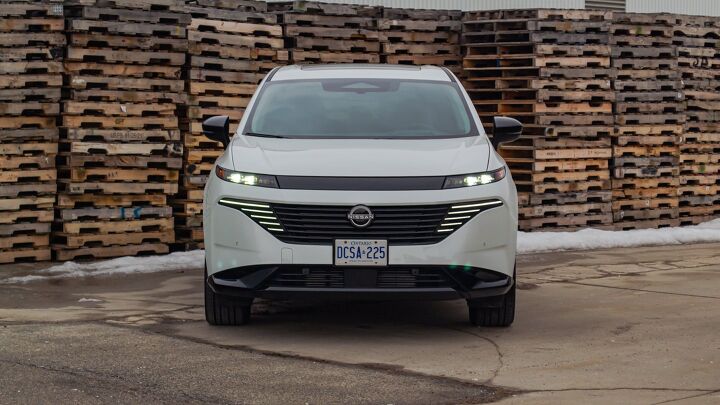
Kyle Patrick: We first drove the latest Nissan Murano over a year ago and personally, I’m still not sure on the looks. The best Muranos tended to either set a style tone for the brand or go their own way entirely, and this one doesn’t quite do either. There are some great elements, don’t get me wrong: the proportions are excellent and it maintains the huge wheels (21-inchers) that have been part of the Murano recipe since day one. In fact, it seems slightly more compact than its 193-inch long length. Nissan has remixed the chrome roofline blade from the Z here, and even though it’s a bigger canvas, it works—especially that intersection at the D-pillar. I also like the taillights, which seem almost French in design and are full of tiny lighting elements. It looks cool, though the lights lose their brilliance at an angle, like watching an old TV. I just don’t like the nose and its Daytona-mounting-a-Kicks design.
The Murano’s cabin may not be quite as swanky as the Crown Signia’s but it’s close and, like previous Muranos, takes a unique approach for the brand. The color-changing trim that dominates the dashboard design is inspired by the island from which the SUV takes its name, adding a world traveller vibe. The super-slick wodden touch controls from the Ariya sit below it: not as functional as traditional buttons but so much cooler. Earning the Nissan huge style points is the blue semi-aniline leather. Not only does it look fantastic, the front-seat quilting is so intricate that it out-fancies some premium brands.
2025 Nissan Murano Platinum: All the Details


Mike Schlee: The 2026 Toyota Crown Signia has the brand’s corporate front end that’s on basically all of the manufacturer’s vehicles at this point. The heaviest resemblance is that of the Prius, Camry, and of course Crown Sedan. The body shape is less SUV-like than the Murano as the Crown Signia really looks like a raised wagon. We’ve alluded to it before and stick to the analogy that this is the Toyota equivalent of a Subaru Outback (well, at least the old wagony Outback).
We are fans of the Crown Signia’s interior design, even if our specific tester featured too many black materials inside. Adding some visual appeal are details like the rose-gold-like trim across the dash, on the door handles, and around the vents. Also, the way the driver information pod blends into the infotainment screen is well executed, as it looks quite premium.
The door sills are all soft touch, even on the back doors. While on the topic of the rear doors, they also continue the rose gold trim theme on the handles and trim bits. Sometimes rear seat passengers are forgotten about when it comes to interior design, but that’s not the case in the Crown Signia as it feels just as upscale in the back as it does the front.
2025 Toyota Crown Signia: All the Details

Comfort and Space

KP: No surprise here, as the taller and wider Murano has the Crown Signia beat in nearly every interior measure. The front seats are super comfy with Nissan’s Zero Gravity tech, and while they feature heating and ventilation like the Toyota’s front thrones, a massage function is on the menu too. Note that it is quite noisy, however. Out back the Nissan does have a hair less rear headroom and about an inch less legroom, but also a stiffer cushion. There is a noticeable dip in material quality in the back row too.
Keeping the second-row seats upright, the Murano has the cargo advantage by around 30 percent, with nearly 40 cubic feet of flat load floor. The Crown makes more use of its seats-down space though, shrinking the gap.

MS: The Crown Signia is a bit of an odd vehicle in that the front seats have less headroom on paper than the rear seats and that definitely is the case in real world testing. The front compartment feels like a mid-size sedan, with a low roofline and sloping in side windows. It lacks the airy feel of the Murano.
The rear seats are the opposite. There’s plenty of legroom, decent amounts of headroom, and an airy feeling thanks to large side windows and the panoramic moonroof. Even if it’s not as spacious as the Murano’s rear seat area, it feels more comfortable. Behind the back seats is a cargo area that’s relatively deep, but not that tall, a trademark of a wagon body.
Engine and Fuel Economy

KP: Since it debuted in 2003, the Murano has featured a V6 and a CVT. This generation bins the classic VQ for the 2.0-liter turbo-four found in the Infiniti QX60, complete with a nine-speed transmission. With variable compression the promise is more power and more efficiency, but the results are mixed.
The Murano’s 241 horsepower and 260 pound-feet of torque are solid figures, essentially swapping places compared to the V6, and more torque is always better for a daily driver. The Murano is packing a lot more weight than the Signia, and in our acceleration tests, it came close to catching that pseudo-wagon.
Where the Nissan loses points is with its transmission. The nine-speed is often confused, and quick stabs at the throttle—admittedly not something that should happen too often in normal driving—results in the ‘box kicking down a few gears and just holding at high revs. We’ve never seen that in other modern cars. Sport mode doesn’t help either; it just makes shifting jerky, going against the spirit of the new Murano.
Naturally this non-hybrid struggles to match the Toyota’s efficiency too. With a 23 mpg average (9.7 L/100 km in Canada) the Murano just edges past the larger VW Atlas Cross Sport we had in our initial comparo, but only matches the more powerful, non-hybrid Hyundai Santa Fe and is way off from the Mazda CX-70.

MS: Under the hood is a 2.5-liter four-cylinder hybrid set-up. Like many Toyota hybrids with all-wheel drive, there is a gas engine and electric motor powering the front wheels, while a wholly independent secondary motor powers the rear wheels when needed on demand. In total, there is 240 hp and an undisclosed amount of torque. But safe to say the latter is more than the Murano.
Catch the Crown Signia in the perfect circumstances and the engine feels more robust than its Nissan competitor. Even on the freeway it pulls hard well into arrest-me-now speeds. But, when the battery is low, or the combination of gearing and speed aren’t optimal, it feels ordinary. The Murano may be a bit slower in most circumstances, but at least power always remains consistent.
One area the 2026 Toyota Crown Signia absolutely dominates the Murano is fuel economy. Officially, it is rated at 39 mpg (6.1 L/100 km) in the city and 37 mpg (6.3 L/100 km) on the highway.
Handling and Driving Feel

KP: Back when the Murano launched, it was pitched as a sort of Z for the family: it had the same engine after all, along with big wheels and some exterior shades shared with the coupe. This one is different: Nissan is pitching it as more of a wellness center on wheels. It’s quiet, refined, and just a little stodgy.
The extra couple hundred pounds make themselves known almost immediately after the low-slung Toyota. The steering has solid weight but almost no feedback, giving the big Nissan a tense feel, like it’s just waiting to relax. Both of these vehicles ride a little firm thanks to their large rolling stock, but the Nissan has the busier ride over anything other than smooth tarmac too. The suspension is also noisier while doing its thing. Braking however is smooth and progressive.

MS: At just over 4,200 pounds (1,900 kg), the Crown Signia is a vehicle that drives lighter than its curb weight suggests. Wearing 21-inch wheels with 235 mm wide tires, this is not a performance vehicle or all that sporty, but it is more responsive and better settled under hard cornering than the Murano. It makes sense as this Toyota is vastly more of a car compared to that Nissan; a point reflected in the Crown’s 6.7-inches (170 mm) of ground clearance.
The steering offers a bit of feel, a bit of weight, but a lot of isolation for a premium first driving experience. The all-wheel drive system takes a similar approach as its main function is to provide assist and stability in slippery conditions, not provide maximum vehicle rotation when cornering.
Technology

KP: Nissan’s twin-screen setup is generally good; the main screen offers more functionality than the Toyota’s but boy oh boy is that navigation not pretty. I appreciate being able to operate the screen right from the steering wheel; responses aren’t the quickest, but I’m keeping my hands where they should be.
Nissan’s suite of driver assists is pretty standard with rear cross-traffic alert and full-range adaptive cruise control, plus the addition of useful things like a see-through hood and around-the-corner camera functions. Nissan’s hands-free ProPilot Assist 2.1 is available as part of a $2,700 tech package in America.
The Murano does cram in a lot of desired tech, including the big pano roof, aforementioned massage seats, and the fractionally better sound system of this pairing (a 10-speaker Bose setup). Wireless charging is standard, though it’s not nearly as functional as the Toyota’s excellent setup.

MS: Our Crown Signia tester came loaded with all the comfort features that should be expected at this price point. There is a driver power memory seat, power passenger seat, heated and ventilated front seats, heated rear outboard seats, heated steering wheel, and more.
On a technology front, there is a customizable digital driver information center, double pane moonroof, power liftgate, wireless Apple CarPlay and Android Auto, and a wireless phone charger. The latter is a clever design that not only actually charges phones consistently, it also nicely holds them in place.
One minor detail we like in the Toyota is the dedicated headlight washer button, an overlooked feature on modern LED equipped cars. One thing we’re not quite as big of a fan of is the infotainment system. It isn’t too hard to use, but it’s not as intuitive or as user friendly as the one in the Murano.
Pricing

KP: Technically, the Murano undercuts the Crown Signia in both the US and Canada. There’s an especially large asterisk at play for the latter, though. In America, speccing a ’26 model to what you see here would run $51,795 including destination. Grab the black contrasting roof or the tech package and then it’s pricier than the Toyota.
The situation in Canada is complicated. When we got these two together, there was a pause on Murano availability in the Great White North; this was actually a 2025 tester, and it would’ve listed for $56,828 CAD including destination, a useful four grand below the Toyota. Now it’s back in production, and the joys of tariffs make it $60,848 CAD. Are we winning yet?

MS: Pricing for the 2026 Toyota Crown Sigina starts at $45,585 in the United States (all prices include destination charges). As tested, the vehicle came in at $51,850. In Canada, there are fewer trim options, as the vehicle comes in one configuration, almost fully loaded. It starts at $59,380 CAD and came in as tested at $61,455 CAD.
Conclusion: Toyota Crown Signia vs Nissan Murano

The spacious Murano has plenty of high-end details and user-friendly features, but against the Toyota Crown Signia, it ends up a bit short when it comes to the premium driving experience, efficiency, and over all special feeling.
Yeah, we may have done it again and just picked the lifted wagon as the winner in a premium SUV comparison. We guess that proves it though; Toyota’s true crossover/SUV/wagon just can’t be beat in this segment, at least for now.
Become an AutoGuide insider. Get the latest from the automotive world first by subscribing to our newsletter here.
Kyle began his automotive obsession before he even started school, courtesy of a remote control Porsche and various LEGO sets. He later studied advertising and graphic design at Humber College, which led him to writing about cars (both real and digital). He is now a proud member of the Automobile Journalists Association of Canada (AJAC), where he was the Journalist of the Year runner-up for 2021.
More by Kyle Patrick




Comments
Join the conversation