


Ford Mustang EcoBoost Performance Review: How Are the Warranty-Approved Performance Parts?

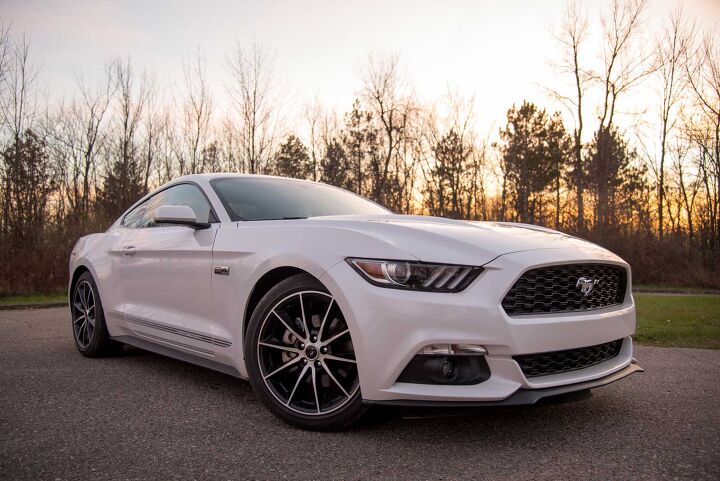


Automotive fanatics are sure to tell you that the only sort of engine that belongs under the hood of a performance car like the Ford Mustang is a traditional V8. According to them, anything less is simply unacceptable.
But in the 21st century, efficiency and responsibility matter more than ever. Gasoline isn’t getting any cheaper plus environmental concerns are top of mind as industry, governments, and private citizens alike work to use natural resources more responsibly.
And if those reasons weren’t enough, not everyone needs the awe-inspiring power dished out by a V8, nor do they want to spend more money up front or on insurance. Responding to this situation, Ford chose to offer an efficient EcoBoost four-banger in the S550 Mustang when it launched several years ago, giving customers an engine option that’s still plenty capable but more in step with modern times.
Sacrilegious or Shrewd?
Despite an acute lack of cylinders, Dearborn’s 2.3-liter turbo is well behaved and surprisingly robust, rated at 310 horsepower and 320 pound-feet of twist. Further improving performance, it’s been bolstered for model-year 2018, with torque output swelling to 350.
It goes without saying, or, as the case may be here, reading, that EcoBoost powerplant is not as stirring as what’s found between the front fenders of GT models, but it’s still pleasant enough you won’t feel like you cheaped-out and bought some cut-rate generic brand.
Get the Flash Player to see this player.
FAST FACTS
| Engine: | 2.3-liter turbocharged four-cylinder |
| Output: | 335 horsepower, 390 pound-feet of torque |
| Transmission: | Six-speed automatic |
| Stock U.S. Fuel Economy (MPG): | 17 city, 25 highway, 20 combined |
| Stock CAN Fuel Economy (L/100 km): | 12.8 city, 9.5 highway, 11.3 combined |
| U.S. As-Tested Price: | $34,281 including $975 for delivery and $4,571 in aftermarket upgrades |
| CAN Estimated Price: | $46,000 |
For those who went the sensible route and acquired a four-cylinder Mustang, you needn’t leave it the way it came from the factory. The go-fast goons at Ford Performance offer a passel of aftermarket parts that enhance this model’s look, feel and expedite its already respectable acceleration.
Modified Mustang
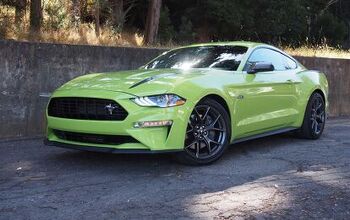
Even though an updated 2018 version has already launched, the folks in Dearborn were looking to highlight the aftermarket goodies available for their venerable pony car. To this end, they dressed up a ’17 model-year coupe with a range of components with the goal of taking an already good machine and making it even better.
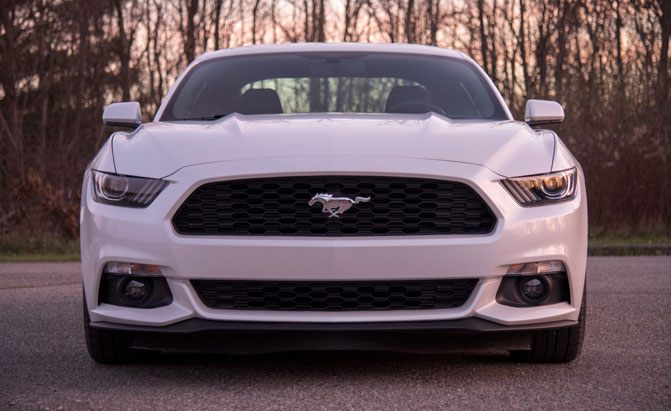
To highlight what’s available in the vast Ford Performance parts catalog, which includes a huge range of items from crankshafts and wheels to overhaul kits and turnkey engines, the Mustang reviewed here was gussied up with nearly $4,600 (est. $5,911 CDN) in EcoBoost-specific goodies, though it’s important to note that installation is not included in that figure. Prices vary based on where you live and who’s doing the work, so make sure to factor that into your budget if you decide to upgrade your car.
Running down the list of aftermarket parts, this Mustang is equipped with things like a strut-tower brace, radiator cover and new wheel center caps. But most the most important changes are functional, including a $1,520 (est. $1,953 CDN) track-handling suspension kit, Ford’s $1,549 (est. $1,991 CDN) cat-back exhaust system as well as a retuned engine-control computer and open-element air filter, a combo that checks out at $725 (est. $932 CDN).

If you’re curious, these components were installed on a very base Mustang, one equipped with just three options: an automatic transmission, a wheel and stripe package, as well as White Platinum paint. Out the door, it cost a very reasonable $29,680 including $900 for destination and delivery (est. $40,000 CDN).
POOOOOOOOOOWER!
So, what do all those upgrades get you? The tune and intake add 25 horses and 70 pound-feet of torque, bringing those totals to 335 and 390, respectively. While no performance bump is mentioned, the freer-breathing cat-back exhaust system could add a skosh to those totals as well.
Naturally, those increases are welcome, but perhaps best of all this vehicle’s three-year/36,000-mile factory warranty is unaffected by these enhancements, provided the parts are properly installed.

Also of note, these upgrades are legal in all 50 states, even California, where fun has been outlawed for decades. Also, they’re available at most Ford dealers and from many third-party distributors so getting your hands on them should be no trouble.
Real-World Results
But focusing on this car’s upgrades, one of the first things you notice is the engine sound… it actually makes some! Stock EcoBoost Mustangs quietly grumble as they go about their business, but in comparison, every time you goose the throttle here, you’re rewarded with a burst of throaty intake rumble, though you’ll still never confuse it with proper V8 music.
Focusing on the opposite end, the freer-breathing exhaust system is also more assertive. It gives the car some bark to match its bite, all without droning annoyingly or getting tiresome on long drives. In short, it’s tastefully aggressive.

Acceleration, even when equipped with a six-speed automatic transmission, is fast. The torque in this modified Mustang starts low and hits hard, surging you ahead. No, it doesn’t have the explosive top-end pull of Ford’s 5.0-liter V8, but around town, it pulls like a diesel. During my week with the car, I even had a bit of trouble getting traction in cold weather since there’s so much twist on tap. Remember, 390 pound-feet is only 10 less than provided by a 2017 GT model.
Further enhancing performance, the gearbox’s performance has been optimized with firmer, faster-feeling shifts.
Naturally, with this package fuel economy will take a hit since the engine is making more power and you’ll undoubtedly be dipping deeper into the throttle more often, but according to the trip computer I averaged more than 21 mpg in heavy-footed driving, just three less than what the window sticker says this car should deliver.

I was pleasantly surprised by this Mustang’s overall performance, but one part of it that’s not quite as nice is the chassis. It drives remarkably well, but I just found it too stiff for use on weather-beaten Midwestern roads. There’s no need for such a starchy suspension setup unless you live on Mulholland Drive or go racing every weekend. I would have been fine with a touch more compliance, though the one-inch drop does give the car an aggressive stance.
For drivers like me, Ford also offers a street-handling suspension kit. It’s a few hundred bucks cheaper ($1,119 [est. $1,438 CDN]), lowers the car about the same amount and is a touch softer for better day-to-day livability.
The Verdict
The assortment of Ford Performance parts highlighted here breaths a little more excitement into Dearborn’s four-cylinder pony car. And that’s good news for owners of 2015 to 2017 EcoBoost Mustangs because all these components install without issue. As for the substantially updated 2018 model that just launched, it’s unclear right now what enhancements will be offered, but stay tuned.

Feeling like a cohesive package, I’ve been pleasantly surprised by this suite of factory-backed upgrades, especially the engine recalibration kit. If you’ve got a four-cylinder Mustang, I’d recommend grabbing that tune and Ford’s cat-back exhaust system to enjoy a faster, more finessed car. Hell, these changes might even be enough to make dyed-in-the-wool gearheads think twice about getting a V8.
Discuss this story on our EcoBoost Ford Mustang Forum
LOVE IT
- Factory warranty remains
- Makes nicer noises
- Increased torque
LEAVE IT
- Ride on the stiff side
- Still not a V8
Born and raised in metro Detroit, Craig was steeped in mechanics from childhood. He feels as much at home with a wrench or welding gun in his hand as he does behind the wheel or in front of a camera. Putting his Bachelor's Degree in Journalism to good use, he's always pumping out videos, reviews, and features for AutoGuide.com. When the workday is over, he can be found out driving his fully restored 1936 Ford V8 sedan. Craig has covered the automotive industry full time for more than 10 years and is a member of the Automotive Press Association (APA) and Midwest Automotive Media Association (MAMA).
More by Craig Cole






Comments
Join the conversation
I bought a 2016 Mustang EcoBoost in October,2015 equipped only with the Competition Pkg and a manual trans. My goal was to buy the Ford tune when it was available and add it to my Ford extended 100,000 mile warrantee. The package was finally released by Ford Performance about a year and a half later. I had been in contact with Ford Perf. They told me that while the package would have the Ford Performance Warrantee that it was not compatible with adding it to my 100k Ford production extended warrantee. I was told to read the small print on the site. I did so and realized that: 1) The 3/36 Ford Performance Warrantee begins when the car is built. That means that because the tune wasn't released until well after I bought the car that warrantee was much shorter. Since the tune is available now, if you purchase a new Mustang you will have the complete Ford Performance warrantee. 2) The 3/36 Ford Performance Warrantee is not a Ford production warrantee and the two do not relate even though the word "Ford" is in both. 3) Even though the two warrantees are incompatible as described, that if a warrantee issue occurred outside the Ford Performance Warrantee I was legally allowed to take Ford to Court to prove that it was the performance tune that caused the failure. As a retired Ford engineering person I realized that since the tune promised somethilng like 100 lb/ft of torque increase between about 5000 and 6500 rpm and similar increases in other areas if a failure in my transmission, rear axle system or internal engine components, as an engineer I would have to agree that such failure might be forced to think that it may have occurred due to the increased power of the tune. I am writing this because I want anyone who purchases the tune to understand it's implications. I didn't until I nit picked the 'small print'. Others less involved with engineering might have overlooked these factors. You can tell that since I bought a Ford extended warrantee I tend to be cautious even though I doubt that I will have a problem on my production Mustang. I hope that anyone who purchases a Mustang also does not have any issues with or without the Ford Performance tune. Ford makes reliable vehicles. I am writing this to explain that while I really wanted to buy the tune, I didn't.