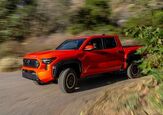


2026 Hyundai Palisade Hybrid First Drive Review: Flagship, Evolved


It’s nice to be right.
Ever since I drove the 2026 Hyundai Palisade earlier this summer, I’ve been convinced it would be the clear segment leader if not for one missing feature: a hybrid powertrain. The standard 3.5L V6 is good enough to fend off the competition’s default engines, but something with more power, better fuel economy—or ideally, both—would cement its position at the front of the pack.
We knew a hybrid was coming ever since Hyundai first showed off its swanky new three-row flagship, but the 2.5-liter turbo-four setup was an unknown quantity. Well now I’ve driven it, and I’m happy to report it elevates an already impressive experience more than the on-paper figures would suggest.
(Editor’s Note: This First Drive was conducted at the annual AJAC TestFest event in Ontario, and thus is based on a shorter amount of driving than typical first drives.)
2026 Hyundai Palisade Hybrid Quick Take
Take everything great about the new Palisade, then add more power, better fuel economy, and an even more hushed ride: that’s the 2026 Hyundai Palisade Hybrid’s elevator pitch. So long as buyers can swing the higher price it’s the easy engine choice.
What’s New for 2026:

The Palisade entered its second generation this year. Fractionally larger in every measure, it still falls in the middle of the three-row pack at a hair under 200 inches (5,080 millimeters) in length. New looks inside and out coincide with the requisite uptick in technology.
Going for the hybrid funnels buyers into a smaller lineup of trims: four in the US and three in Canada. American buyers still get the option of front- or all-wheel drive like the gasser; all Palisades in Canada are all-wheel drive. The rugged XRT Pro can only be had with the V6. Opting for the hybrid knocks 1,000 lb off the towing capacity, bringing it to 4,000 lb when properly equipped.
Exterior Style:
Hyundai isn’t in the business of giving its hybrids unique styling from their gas-only counterparts. Other than a small badge on the liftgate, this is exactly the same package. Whether you like it or not is obviously up to you, but I will say that it’s grown on me. The Gillette Fusion 5 secondary lighting isn’t subtle, but Hyundai’s light-up trim trick means the Palisade has the same “face” even in the middle of the day.
Pronounced wheel arch creases and that strong, contrasting D-pillar give the Palisade a much more upmarket profile. Big 21-inch alloys don’t hurt, either.
2026 Hyundai Palisade Hybrid: All the Details

Powertrain and Fuel Economy:

This is the first application for Hyundai’s latest hybrid setup. Essentially it takes the 2.5-liter turbocharged four-pot from the Santa Fe—here making 258 horsepower and 260 pound-feet of torque—and joins it to two electric motors. The first (“P1”) handles duties typically taken care of by mild-hybrid setups: starting the engine and recharging the 1.65-kilowatt-hour lithium-ion battery pack. Meanwhile the 72-horsepower “P2” takes care of both propulsion and regenerative braking. All this happens through a familiar six-speed automatic transmission. Total tallies for the system are 329 hp and 339 lb-ft.
On startup the Palisade will hum along on electrons for a short while until the engine wakes up, doing so with a faint murmur. The extra 42 ponies are welcome, but it’s the torque increase that defines the hybrid. Not only is the peak substantially higher, all that twist is available without needing to rev the engine out.

Which is a good thing, because while the six-speed’s ratios are well-spaced for this torquey powertrain, the transmission isn’t the most responsive. Dig deep into the throttle and kickdown happens with all the urgency of a spotty WiFi signal. Switch over into Sport mode and it’s fractionally quicker.
My short drive wasn’t enough to reliably suss out whether the quoted 8.1 L/100 km figure is easily attainable. I’ll be saving that challenge for a little later in the year…
Ride Quality and Comfort:

The Palisade already had one of the quietest cabins in the segment, and the hybrid only further muffles the decibels. Yes, this is the fanciest-pantsiest Calligraphy (Ultimate Calligraphy) in Canada, stuffed full of thicker glass and increased sound deadening. But that’s all true on the gasser as well. Everything is hushed here, with little wind, tire, engine, or suspension noise.
The front seats are mega-comfortable, with the quilted Nappa leather seats offering heat and ventilation in the first two rows, and even third-row heating on this top trim. Because the Palisade offers up Hyundai’s Relaxation seat in the front and middle rows—though obviously not all at the same time—there is a good amount of adjustability and lower-leg support built into the thrones. Note that the hybrid’s battery placement does slightly eat into second-row legroom; we’re still talking an ample 41.4 inches (1,052 mm), mind you.
The third row is fairly easy to access via the one-touch controls on the second-row captain’s chairs. Way-back riders sit a little low, but there’s good space for their legs (32.1 in / 815 mm) and heads (37.7 in / 958 mm). The one-button solution for folding both rows, right from the liftgate area? Great, if only the movement wasn’t so slow you could catch a podcast during it.
Interior Style and Quality:

Yep, this interior still rocks. With clear inspiration from mid-century furniture, the Palisade cabin is a cohesive space with a warm, humanist feel, even in the all-black look of this tester. Smart uses of texture and negative space punctuate the dashboard and center console, and soft-touch materials abound. Nevermind the mainstream competition; the Palisade cabin can even shame some premium options.
While the Palisade has a large touch-sensitive panel for its climate controls, Hyundai still employs physical buttons and switches for many of the primary functions within the cabin.
Tech and Safety:

Like the also-new-for-2026 Toyota RAV4, the Palisade comes with a built-in dashcam function. This is a huge move for both OEMs, baking the extra level of security and peace of mind right into the package. Recordings can also include multiple vehicle parameters. Unfortunately for Palisade shoppers, it is exclusive to the top trim.
The rest of the tech suite is typical Hyundai: well-stocked and well-executed. The infotainment is simple in the right ways, never taking too long to get to the specific setting desired. A surround view monitor and wireless charging both show up early in the trim walk. The 14-speaker Bose setup is darned powerful, too. Don’t forget about the disinfecting UVC storage space, either.
Value, Dollars, and Sense:

Pricing for the Palisade Hybrid begins at $49,120 ($62,599 CAD) including destination. That’s a roughly $7,000 to $8,000 upcharge from the gasser’s starting price, but remember that the Palisade Hybrid starts at the higher-content SEL Premium (Luxury in Canada) trim. In America, where that trim exists on both models, the difference is just $2,200.
Calligraphy versus Calligraphy? Same gap in the US, and a $3,200 CAD gap in Canada. By the EPA’s own calculations the hybrid would pay for itself in less than five years at current gas prices and 15,000 miles per year.
Final Thoughts: 2026 Hyundai Palisade Hybrid First Drive Review

With the 2026 Hyundai Palisade Hybrid, the other big H has heard our cries for a better engine. Not only does it post excellent fuel economy for something so large, it does it with unmatched refinement and serious dashes of style inside and out. Unless you want the rugged XRT Pro or can’t swing the extra initial outlay, the hybrid is the correct choice.
Become an AutoGuide insider. Get the latest from the automotive world first by subscribing to our newsletter here.
Kyle began his automotive obsession before he even started school, courtesy of a remote control Porsche and various LEGO sets. He later studied advertising and graphic design at Humber College, which led him to writing about cars (both real and digital). He is now a proud member of the Automobile Journalists Association of Canada (AJAC), where he was the Journalist of the Year runner-up for 2021.
More by Kyle Patrick




Comments
Join the conversation