


Do Engine Start-Stop Systems Actually Help Your Fuel Economy?

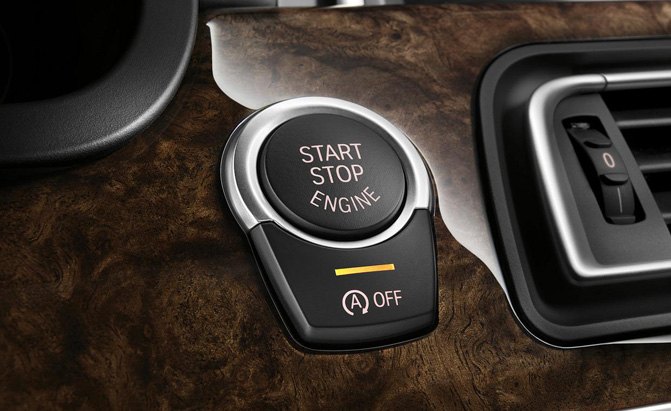
Many new cars come with automatic engine start-stop. These systems are designed to save the fuel wasted at idle by turning the engine off when you come to a stop.
These systems are becoming more and more common in cars and trucks. Even the Ford F-150 is arriving with this system as standard equipment, promising more MPGs.
But the fuel spent during idle seems insignificant, right? Even the EPA’s fuel economy tests seem to downplay the significance of these systems. How much fuel can really be saved, and can everyone benefit from this technology, even if they spend most of their commute on the highway?
Here’s how it works for the driver: When you come to a stop, like you would at an intersection and hold the brake while you wait for the light to turn green, the engine will shut off. On cars with manual transmissions, you usually have to put the car into neutral in order for the engine to shut off. As soon as you let off the brake or engage the clutch, the engine will automatically and quickly fire up, so you can get on your way again. These frequent restarts require a different starter motor that’s more robust and paired to a different, tougher battery.
See Also: EPA Moves To Walk Back Emissions Regulations
Furthermore, unlike when you turn off your car entirely, the rest of your car’s features will remain on even if engine start-stop system is active. That means you still get A/C, radio, navigation and all that. A bigger battery helps with that, and some cars even feature an extra battery or a super capacitor.
Still, despite updates to the new five-cycle EPA test, it may be hard to see the tangible benefits of an engine start-stop system.
“The engine idle duration for this test is fairly representative,” explains Thomas Recke, a PR specialist for Continental Automotive. Continental is an automotive supplier that provides engine start-stop technology to automakers. “However, the idle time is stressed with extreme temperatures: the A/C test cycle exposes the engine to 95°F, whereas the cold city test is performed at 20°F. The engine must remain on in order to provide climate control.” This helps to explain the unimpressive EPA ratings of cars with engine start-stop.
It also helps to point out that the effectiveness of engine start-stop systems can fluctuate for a number of reasons.
“Fuel savings will vary depending on the type of start-stop system, driving style and driving cycle,” explained Recke. “The average U.S. driver with a basic system will save around 4 percent.” He also explained that more advanced systems, like those used in mild or full hybrids, can improve savings even more.
See Also: Stop-Start Might Be On The Chopping Block
A 4 percent improvement in fuel economy isn’t too shabby, but Recke pointed out that can change drastically based on what kind of driver you are and the type of commute you have. A city driver, for example, who can spend about a quarter of their drive time stuck idling in traffic, can see an improvement up to 8 percent by driving a car with an engine start-stop system. On the other hand, aggressive drivers who roll through their stops or drivers who spend much of their time on the highway will see less of an improvement on their fuel consumption.

“Eliminating rolling stops as well as creeping after engine stop will help maximizing the fuel savings,” explains Recke. “Additionally, reducing the A/C and heat will help.” He pointed out that most new cars have automatic controls that reduce A/C and heat automatically when the engine is turned off.
“The most important step to maximize benefits is to drive normally,” explains Ulrich Muehleisen, head of marketing and product development for starters and generators at Robert Bosch LLC. Bosch is another automotive supplier that provides engine start-stop systems. “When the system is active, any full stop will start providing immediate benefits. The biggest impact will be from the system activating regularly during normal driving.”
Interestingly enough, while there’s a decent impact at the pumps, your wallet may be suffering in different ways. Powering this new technology are advanced batteries. “Start-stop batteries are put under more load than a normal battery,” said Muehleisen. “So every OEM has taken steps to strengthen and protect the batteries. All OEMs have implemented battery monitoring systems. Almost all OEMs have upgraded their start/stop batteries, which are capable of handling the extra cycling.”
Muehleisen pointed out that these batteries still meet all the same durability requirements as traditional batteries, while still offering the extra juice to handle start-stop responsibilities. “Since these batteries are not mainstream quite yet, they are a little more expensive, but should be easy to find,” he said.

It’s clear that there are some benefits to these systems, but it may depend completely on how you drive. If you think you’re spending too much of your commute idling, then you can probably earn a few MPGs by owning a car with engine start-stop. But don’t forget that the extra load on the battery may cause it to wear out sooner, and it may be more expensive to replace.
Become an AutoGuide insider. Get the latest from the automotive world first by subscribing to our newsletter here.

Sami has an unquenchable thirst for car knowledge and has been at AutoGuide for the past six years. He has a degree in journalism and media studies from the University of Guelph-Humber in Toronto and has won multiple journalism awards from the Automotive Journalist Association of Canada. Sami is also on the jury for the World Car Awards.
More by Sami Haj-Assaad








Comments
Join the conversation
Assuming that oil is not in short supply (and it doesn't seem to be) the 4% savings is insignificant to both the consumer and the government. In fact the consumer comes out poorly because the technology required to implement stop/start costs more that the money saved by 4% fuel savings especially noting that the technology must be paid for at car purchase and during loan repayment.
If one looks at pollution and use of the earth's resources in a sense broader than exhaust fumes, the extra components required and the extra battery need surely outweigh the 4% savings.
Then there's the ugly little reality that the Los Angeles fires wiped out years of pollution reduction by California .... and we dare not mention volcanic emissions.
"All big ticket items that are destined to early failure." "Simple stuff works better and is easier to maintain." "wish these systems were an option, rather than showing up on more and more models."... That's the intent regarding the 21st century business model. It's all about deriving maximum resources from those who are expected to remain dependent and clueless. This is a much bigger social issue than merely buying durable, dependable autos.
Independently thinking, DIY individuals serve no advantage to the 1% ruling class. Ignorance is what serves elites. Now, A.I. comes to replace thinking and, inevitably, personality itself. It's not intended to make life better for the human species. It's intended to make life more convenient and entertaining for elites. The picture, Elysium (2013) pretty well lays it out how elites envision future resource allocation irrespective of economic and political systems. Think of their vision as conceptualizing the ultimate gated community.