

2026 Toyota Corolla Cross First Drive Review: Playing It Safe


SONOMA, CA—When we did our small SUV mega comparison last year, the Toyota Corolla Cross finished second, and it was my personal pick of the field.
That was almost entirely because of the CC’s available hybrid powertrain, which was unique in the segment at the time. If you’re buying something small and affordable, why wouldn’t you want to save about 40 percent at the pumps? That was my reasoning, anyway. For ‘26 Toyota won’t be the only one offering an electrified option—hello, Subaru Crosstrek Hybrid—so the big T is freshening up its littlest crossover with tweaked looks and a better cabin. We headed to Sonoma, California to get to know the 2026 Toyota Corolla Cross lineup and see how it is staying competitive in a tough segment.
2026 Toyota Corolla Cross Quick Take
With the same easy-going driving experience as before and a better cabin, the 2026 Toyota Corolla Cross should keep buyers coming back, but it can still feel sparse against other, better-equipped competitors.
What’s New for 2026:
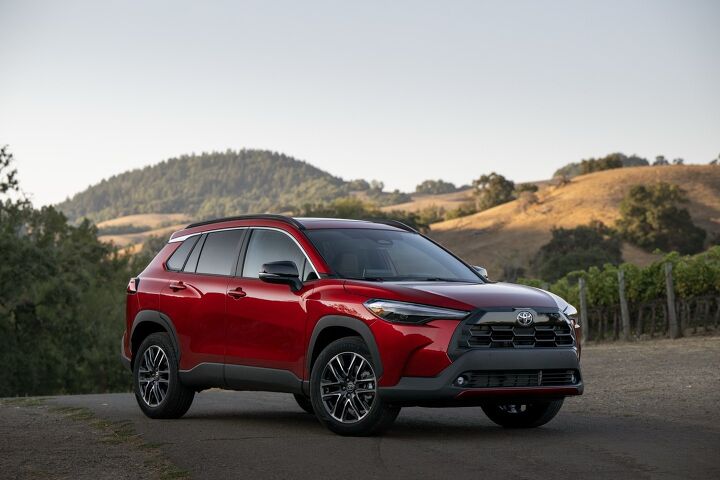
Toyota is keeping the visual difference between the gas and hybrid Corolla Cross models for 2026. The former is barely different from before, with a redone grille complete with hexagonal pattern and a bar along the top to house the Toyota logo. The hybrid model gets a new nose too, with the body-color cheese-grater pattern we’ve seen on a few other models, most notably the Crown Signia.
The cabin gains a redesigned center console, larger infotainment screen and, on the top gas XLE trim, the option of a Portobello hue for the SofTex seating.
Exterior Style:

The darker headlights and taillights of the hybrid model are now standard on all trims, adding a bit more visual muscle to the Corolla Cross. Pretty, machine-finished 18-inch alloys are new for the XLE trim, and Toyota’s excellent Cavalry Blue paint is available on most of the CC trims, gas or hybrid. Same goes for Soul Red metallic, which quietly joined the lineup last year; yes, Mazda’s iconic hue, all thanks to the two brands sharing the Alabama production plant. Meanwhile, the hybrid XSE’s 18-inch alloys are black, and were previously on last year’s Nightshade Edition.
If you didn’t like the Corolla Cross before, the changes are unlikely to sway you.
Powertrain and Fuel Economy:

Both Corolla Cross powertrains are unchanged for 2026. The gas models retain the 169-horsepower 2.0-liter engine, with an available mechanical all-wheel drive system that can send up to half the power to the rear axle or disengage it entirely, contributing to the model’s 30 mpg combined figure. The front-drive gas XLE is what Toyota brought to the event, and it remains… fine. Sluggish if anything, because its meagre 152 pound-feet of peak torque doesn’t join the party until 4,400 rpm, meaning there’s plenty of drone from the CVT. As an entry-level engine it gets the job done.
The hybrid remains the star. The fifth-generation setup debuted on the Prius and it packs the same 196 system horsepower here with the standard electronic all-wheel drive. The constant blending of the gas and electric systems is always smooth, endowing the CC Hybrid with the added thrust you’d typically associate with a larger displacement engine. With a combined fuel economy figure of 42 mpg—easily achievable on the hilly roads around Sonoma—the hybrid quickly recoups the added outlay over an equivalent gas AWD model.
Handling and Drivability:

Picking the hybrid, there’s barely a weight penalty, too: the 3,430-pound XSE carries only 105 more pounds than the XLE AWD model.
Handling is typical mainstream Toyota, as everything rides on some permutation of the brand’s TNGA platform these days. The steering is light, consistent, and predictable, the CC Hybrid cleanly tracing desired lines en route to the track, with an acceptable level of body roll. The brakes, measuring an even 12.0 inches up front and 11.1 inches out back, are smooth and progressive.
Since the XLE available here is front-drive, it carries 260 fewer pounds. It still rolls on 225-width tires, so initial turn-in feels just a little sharper.
Ride Quality and Comfort:

The hybrid has better on-road manners, too. The added torque of the setup means that the e-CVT doesn’t make as much of a racket as the conventional CVT in the gas model. This isn’t a part of the market known for cabin calm, so it’s nice to get those quieter moments.
Front-drive gassers make do with a simpler torsion-beam rear suspension, which can make for a busier ride over rough surfaces. The roads around Sonoma were largely smooth however, so that was never an issue. Take that into consideration if your daily commute is littered with potholes.
Seat comfort remains a strong point in the Corolla Cross, with well-cushioned seats and a natural driving position. The dashboard design does impinge on front-passenger legroom for taller folks, mind you. The CC also has one of the tighter rear rows: I’m able to sit behind my front seat position easily enough, but anybody taller than 5’10” (or with a longer inseam) will want stops to stretch.
Trunk space is still a useful 19.6 cubic feet with the seats up in front-drive Corolla Crosses; that shrinks to 17.1 cu ft in AWD gas and hybrid models.
Interior Style and Quality:

If there’s an aspect of the Corolla Cross we’ve disliked since day one, it’s the cabin. The basic dashboard design we could accept; the barren center console always felt particularly low-rent, however. That changes this year, with a rectilinear lower section that not only looks better, but proves more useful. The seat and wheel heating controls no longer look like afterthoughts, and Toyota has embiggened the wireless charger while also changing the material for a better grip.
The Portobello color scheme is just as good here as it is in the various Toyotas it has previously appeared in. Hybrid buyers will miss out; the XSE instead has the option of blue highlights around its otherwise black SofTex setup.
Tech and Safety:

Two steps forward, one step back: that’s the best way to sum up the larger available 10.5-inch touchscreen on the X-trim CC models. The added real estate makes menus like satellite radio easier to navigate, but the flip side is the switch to volume buttons instead of a knob. Why, Toyota, why?! The available digital instrument cluster has no such issues: it’s easy to read, responsive, and offers a good amount of customization without seeming daunting.
Toyota continues to offer a broad suite of standard driver assists across the Corolla Cross range under the Toyota Safety Sense 3.0 umbrella. This includes automated emergency braking with pedestrian detection, lane departure alert with steering assist, auto high beams, road sign recognition, and full-range adaptive cruise control. The latest iteration of Toyota’s lane-keep works well without being too intrusive. Proactive Drive Assist, a sort of regular-driving cruise control with “gentle” steering and braking capabilities, can still be overly conservative, braking at the first sign of a curve in the road. It can be turned off and will remain off on ignition cycling.
Value Dollars and Sense:

Pricing for the revised Corolla Cross starts from $26,130 including destination, netting buyers a front-drive L model rolling on 16-inch steelies with covers. Adding AWD is a reasonable $1,300 upgrade. The XLE starts from $31,055, representing the top of the gas lineup.
Hybrid pricing isn’t far off with the Corolla Cross S ringing in at $30,490, though it’s important to note that mean standard AWD. The XSE I drove would go for a hefty $37,030; that price includes the black roof ($500), Convenience Package ($1,250 for the moonroof and power liftgate), and JBL audio upgrade ($800).
Final Thoughts: 2026 Toyota Corolla Cross First Drive

The 2026 Toyota Corolla Cross doesn’t dramatically alter the formula for Toyota’s small SUV. True to its name, it is the Corolla of the high-rider scene: inoffensive and easy to drive. The hybrid remains the pick here, with better road manners and fuel economy, though price creep has the range-topper nearing the next class up. Stick to the middle ground and the Corolla Cross should serve you well.
Become an AutoGuide insider. Get the latest from the automotive world first by subscribing to our newsletter here.
Kyle began his automotive obsession before he even started school, courtesy of a remote control Porsche and various LEGO sets. He later studied advertising and graphic design at Humber College, which led him to writing about cars (both real and digital). He is now a proud member of the Automobile Journalists Association of Canada (AJAC), where he was the Journalist of the Year runner-up for 2021.
More by Kyle Patrick





Comments
Join the conversation
If it is an SUV or a crossover, I´m not interested.