


Video Game Throwback: Grand Prix Circuit - The First Sim Racer?


Earlier, I discussed Ayrton Senna’s Super Monaco GP II and declared it one of the best F1 games ever made for its era. But I would be remiss not to mention another fantastic Formula 1 game from a few years earlier—Grand Prix Circuit.
Launched in 1988 for various personal computer platforms, this was one of the first racing games where simulation was at the forefront. Accolade tried hard to make the racing feel more real-life authentic than arcade-like. Of course, judged against today’s games, this may seem like a hilarious claim for such a primitive racer, but in some ways, the brand did succeed.
Car Control is Key

The gameplay consisted of the usual cockpit view with a scrolling track that was in fashion at the time. But Grand Prix Circuit was able to convey the feeling that the player was actually controlling and moving the car instead of just adjusting the track's position. Part of this sensation came from the fact that the car had to be shifted up and down through the gears, and brakes were a requirement for all but the fastest of corners. This was not a game where one could merely press the gas button and bounce off walls through corners.
Of course, attempting to be a simulation meant the difficulty level was high. Even with the game’s adjustable difficulty level on the easiest setting, it was hard to keep the car unscathed and ahead of the AI opponents. Well, at least it was for nine-year-old Mike. But it didn’t deter me, as even at that age, I loved the level of control this game offered compared to early arcade racing games like Outrun.

I did not own the game myself, but one of my close friends did. I think this made me love it even more, as I would only get to play it once every few weeks. The two of us would take turns co-driving the car—one steering, accelerating, and braking, while the other was responsible for changing the gears.
It’s in the Details
The level of detail in the cockpit was great with fantastic little touches like the fire suppression button, ignition switch and fuel cut off. Another nice touch I always loved on the main screen was the difficulty meter that represented the easiest difficulty with a picture of an early 20th century style F1 car, and the most difficult level had an image of a modern F1 car.
The graphics overall were well rendered for their time, but the sound effects left a lot to be desired. There may not be a racing game with worse engine and tire noise.
Realism


Grand Prix Circuit featured three cars to choose from, the McLaren MP4/4, the Williams FW12C and the Ferrari F1/87/88C. Each car came complete with specifications and details (even if they didn’t all quite match up the actual race car).
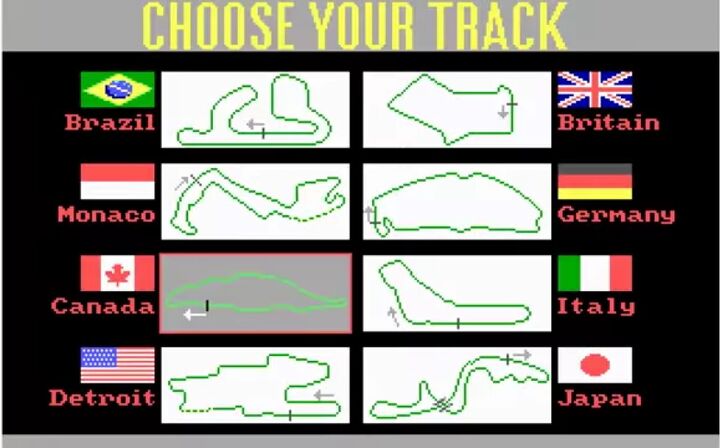
There were eight tracks to choose from in total, which were all real-life replications of tracks used in Formula 1 in the late 1980s. Special shoutout to Circuit Gilles Villeneuve and the Detroit Street Circuit.
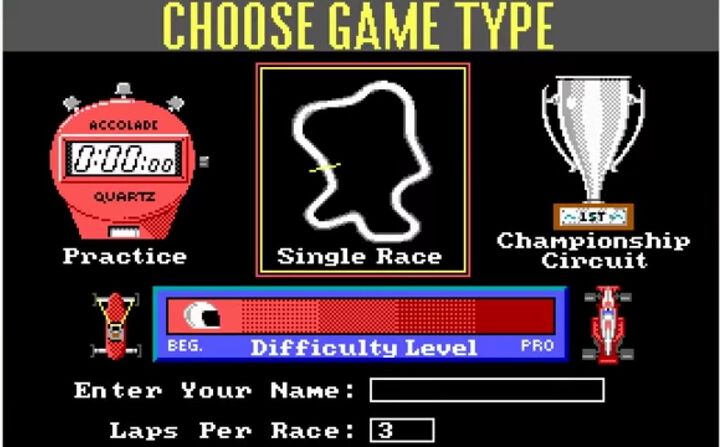
Three game modes were available: Practice, Single Race, and Championship Circuit. The latter was an eight-race championship mode mimicking a mini F1 season. It was the most comprehensive take on an actual racing series season that I can remember up to that point.
This was my indoctrination into simulation racing games, and it got me hooked into the genre—one I still enjoy today.
Become an AutoGuide insider. Get the latest from the automotive world first by subscribing to our newsletter here.

A 20+ year industry veteran, Mike rejoins the AutoGuide team as the Managing Editor. He started his career at a young age working at dealerships, car rentals, and used car advertisers. He then found his true passion, automotive writing. After contributing to multiple websites for several years, he spent the next six years working at the head office of an automotive OEM, before returning back to the field he loves. He is a member of the Automobile Journalists Association of Canada (AJAC), and Midwest Automotive Media Association (MAMA). He's the recipient of a feature writing of the year award and multiple video of the year awards.
More by Mike Schlee


Comments
Join the conversation