

Ford Adds Lithium-Ion Phosphate to Its Portfolio of EV Battery Options
Ford is diversifying the battery chemistry in its EVs. Could that mean cheaper Ford EVs in the near future?
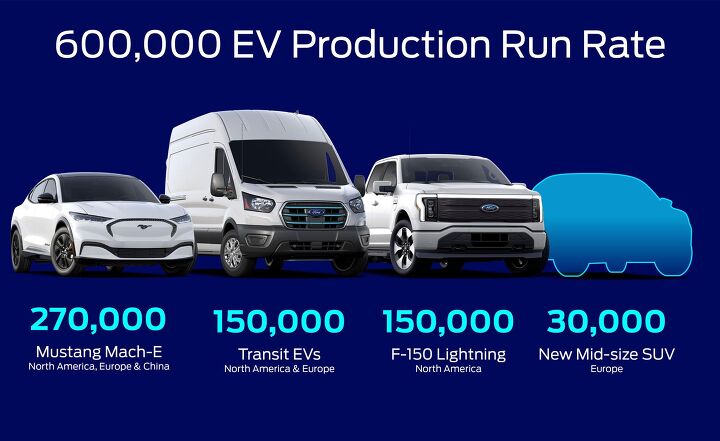
On June 21, Ford released plans to churn out 600,000 EVs by late 2023, and 2 million EVs by 2026. Right now, the brand claims about 270,000 Mustang Mach-Es, 150,000 electric Transits, and 150,000 F-150 Lightings comprise the 600,000 by 2023 number, along with a forthcoming Europe-only EV crossover. Yet, the two million electric vehicles sold mark can’t come without more diverse battery sources. Ford says that by 2024, certain trims of the Mustang Mach-E and F-150 Lightning will be powered by a Lithium-Ion Phosphate (LFP) battery.
Ford’s LFP batteries come from a new deal solidified by battery manufacturer Contemporary Amperex Technology Co., Ltd. (CATL). CATL will supply batteries in conjunction with LG Energy Solutions — it’s all hands on deck to get Ford EVs on the road.
LFP batteries don’t contain cobalt or nickel and are cheaper to build and produce. However, LFP batteries aren’t as power-dense, so they likely would be in lower-trimmed vehicles that aren’t expected to drive as far. Ford claims that LFP batteries are 10 to 15% cheaper in terms of material costs while reducing its demand for rare earth heavy metals.
Ford says that diversifying battery production and chemistry is crucial to ramp up EV production. The brand foresees demand for its EVs cresting 90%, beating out most industry expectations. Only time will tell if a cheaper-to-produce LFP battery will allow for cheaper Ford EVs without any hindrance to range or performance.
Become an AutoGuide insider. Get the latest from the automotive world first by subscribing to our newsletter here.

Kevin has been obsessed with cars ever since he could talk. He even learned to read partially by learning and reading the makes and models on the back of cars, only fueling his obsession. Today, he is an automotive journalist and member of the Automotive Press Association. He is well-versed in electrification, hybrid cars, and vehicle maintenance.
More by Kevin Williams


Comments
Join the conversation