


Chemical Guys InSynchro Scratch & Swirl Remover Kit Review


When cars are brand new, their paint sparkles. The right hue on the right vehicle can really make it stand out. But as the years pile on, and the perils of daily life attack the exterior of your prized ride, the paint starts to suffer. Swirls, chips, scratches, and abrasions are the nemesis of an exterior’s fancy finish.
That’s why products like the Chemical Guys InSynchro Scratch & Swirl Remover Kit were invented. The goal, to help erase some of a vehicle’s blemishes to restore a bit of that luster. Officially, Chemical Guys states this kit should help remove light to medium scratches, swirls, water spots, and other paint defects.
How It Works
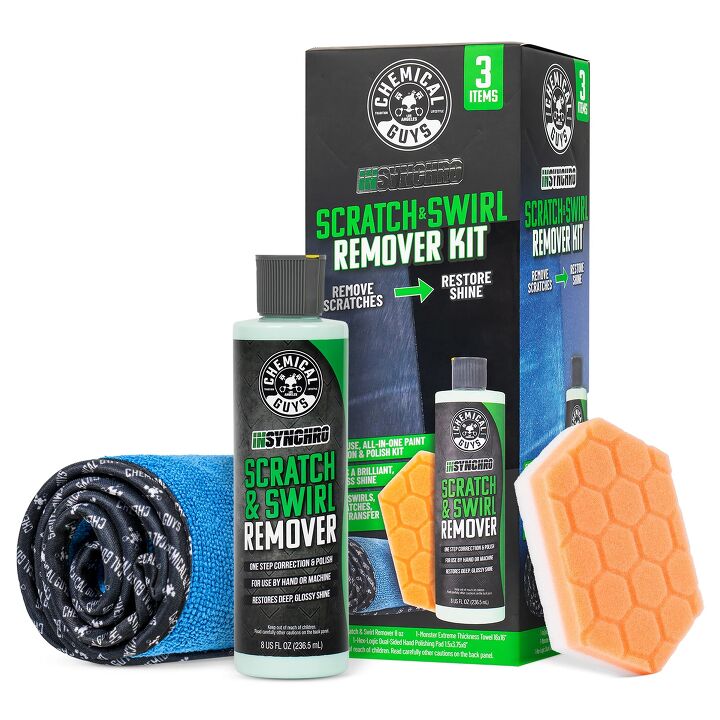
The beauty of this kit is that it requires to power tools or special techniques to apply. After washing and drying your vehicle, simply squirt a bit of the solution onto the Dual-Sided Hex Logic Hand Polishing Pad and start buffing that vehicle. Chemical Guys recommends that linear motions are used while spreading out the formula across the paint, using moderate pressure. Once satisfied with the amount and time spent working out the swirls and scratches, wipe the excess compound off with the provided Monster Extreme Thickness Towel and buff up your vehicle’s shine.
It’s safe to apply a second coat on areas that still have some paint issues. Once all done with the InSynchro Scratch & Swirl Remover, Chemical Guys recommends using a sealant or wax to help maintain the new finish.
Putting It to the Test

To see how the Chemical Guys InSynchro Scratch & Swirl Remover Kit works for ourselves, the company sent us a kit, free of charge, to test and evaluate. Our test subject is my trusty high-mileage 2014 Subaru Forester, which has lived a hard life and is covered in scratches, swirls, chips, and all other manners of paint imperfections.
Applying the compound and rubbing it into the paint is as easy as advertised. I saw lighter scratches disappear completely. More moderate scratches did remain, but were much fainter and less visible from a distance. Did the Chemical Guys’ kit completely restore my SUV’s paint to its original luster? Not quite. But considering how it looked before application, and the fact the Forester has over 150,000 miles on it, the improvement the InSynchro Scratch & Swirl Remover made to the vehicle is quite noticeable, especially from 10 feet or more.
Before Application


The larger scuffs and scratches did remain on my Forester, but some of those are there until I decide to respray the vehicle. One area I was really impressed with the scratch remover’s performance was around the door handles. The oodles of light scratches on the doors directly inside the door handle all disappeared in little time. It really makes that area look 10 years younger.
The Verdict

Overall, I would recommend this kit for those looking to fix a few light blemishes on their vehicle. I applied so much over the entirety of my vehicle, I required the use of a few extra microfiber towels, and it’s best not to apply the compound in direct sunlight. Other than that though, it works just as advertised and I recommend the Chemical Guys InSynchro Scratch & Swirl Remover Kit.
Become an AutoGuide insider. Get the latest from the automotive world first by subscribing to our newsletter here.
The Results


A 20+ year industry veteran, Mike rejoins the AutoGuide team as the Managing Editor. He started his career at a young age working at dealerships, car rentals, and used car advertisers. He then found his true passion, automotive writing. After contributing to multiple websites for several years, he spent the next six years working at the head office of an automotive OEM, before returning back to the field he loves. He is a member of the Automobile Journalists Association of Canada (AJAC), and Midwest Automotive Media Association (MAMA). He's the recipient of a feature writing of the year award and multiple video of the year awards.
More by Mike Schlee







Comments
Join the conversation