
2027 Hyundai Palisade XRT Pro and Santa Fe XRT Off-Road Review


Over the past couple of years, we’ve seen quite a few unibody SUVs hit the market with off-road equipment thrown in for more grip, control, and capability out on the trail. Honda’s Trailsport lineup, Toyota’s TRD fare, plus we can’t forget what Subaru’s been up to for seemingly the longest amount of time. Who remembers those wholesome Paul Hogan commercials from the ‘90s?
From South Korea, Hyundai has been slowly expanding its XRT (Extreme Rugged Terrain) line, that, for 2027, comes in the form of the Santa Fe XRT and bigger Palisade XRT Pro. What timing; both are fresh generations with forward-thinking boxy design, which a bit more clearance and bulkier all-terrain tires look right at home on. But is it enough to come within spitting distance of the capability behind traditional straight-axle trucks with two-speed transfer cases and locking differentials? We recently got the chance to put these two through the ringer on the dirt and up some surprisingly serious rugged climbs in Northern Missouri’s Ozarks, and walked away impressed.
2027 Hyundai Palisade XRT Pro: All the Details

What’s New for 2027:
Well, not a whole heck of a lot, but Hyundai was proud to report to us that it’s slowly expanding its XRT and XRT Pro lines, which will soon include the all-new Tucson XRT Pro—stay tuned for more details on that when we get our hands around its steering wheel. Then, it reminded us that a body-on-frame model is on the way that all signs point to being very off-road-focused in the right trim. Therefore, potentially the flagship model of the XRT Pro badge.
2027 Hyundai Santa Fe XRT: All the Details

Exterior Style:
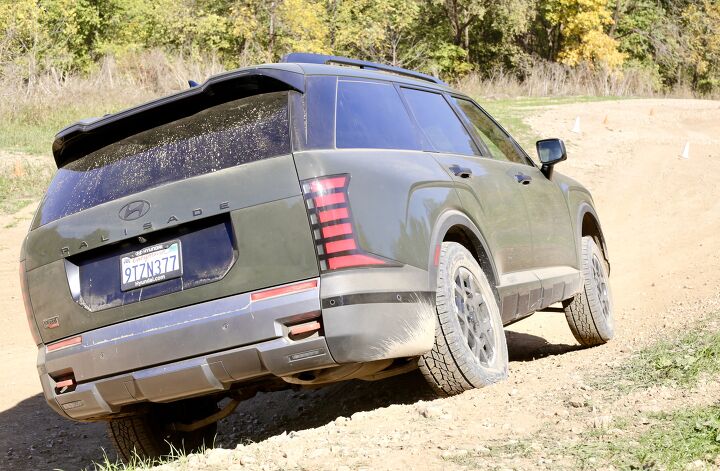
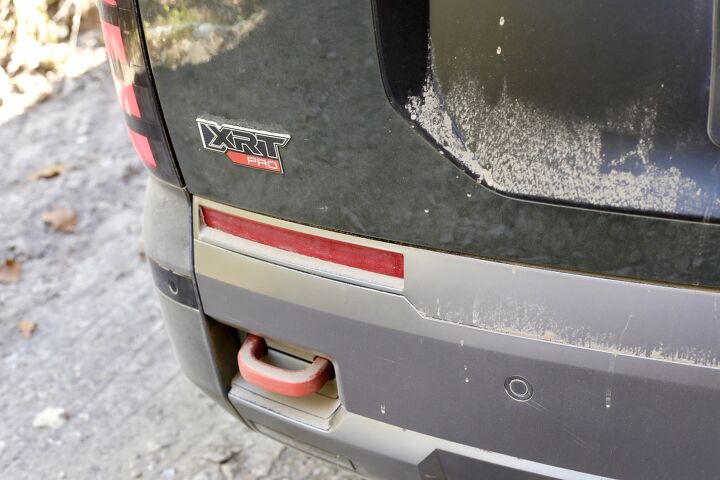
It’s clear-as-day what Hyundai did to the Santa Fe and Palisade on the outside to make them more trail-ready. Red tow hooks adorn the front and rear bumpers, subtle chic badging is found on the rear tailgate, and black 18-inch wheels are wrapped in Continental all-terrain tires. Then, each is raised a bit for better approach, breakover, and departure angles—the Santa Fe sits 1.3-inches higher than the standard model’s seven inches of ground clearance, whereas the Palisade is just an inch higher than its base model’s 7.4.
Both come in a handful of Earthy tones, too, we were partial to our Palisade XRT Pro’s Titan Green, but Earthy Brass Matte is fitting (it’s in the name after all) as is Pacific Sapphire. Between all three, they come together in a Captain Planet-esque fashion (apologies for another ‘90s reference). Then, both XRT and XRT Pro models are adorned in blacked out trim, side mirrors, and wheels, with little real estate given to silver. The Palisade has a unique XRT bumper and grille to truly set itself apart from tarmac-centric trims.

Powertrain and Fuel Economy
Starting with the Santa Fe XRT, the sole engine available is a turbocharged 2.5-liter inline-four making 277 horsepower and 311 pound-feet of torque, which is bolted up to an eight-speed automatic transmission with Hyundai’s HTRAC all-wheel drive. Its Sand and Mud drive modes both split the power 50:50 between the front and rear axles, like a center locking differential that you’d find on other off-road-ready rigs. With its meaty 245/60/18 all-terrains, the Santa Fe XRT is rated at 19 MPG city, 25 highway, and 21 combined, slightly less than non-XRT trims. Finally, towing capacity is rated at 4,500 lbs.
On the other hand, the Palisade XRT Pro relies on good ol’ displacement to make its power. Under the hood lies a naturally aspirated 3.5-liter V6 making 287 hp and 260 lb-ft of torque which also travels through an eight-speed auto and the same HTRAC AWD system as the Santa Fe’s. Yet, it has an electronic rear limited-slip differential to bolster grip in the dirt and mud. Between its bigger six, bigger size, and knobby tires economy is rated at 16 MPG city, 22 highway, and 19 combined.

Handling and Drivability
During our day out in Missouri and Arkansas, we only drove the Santa Fe XRT on public paved roads and found its ride quality and acceleration agreeable. The steering, while quite light, had a good ratio, and body control was generally good on winding country roads. We suspect its bulkier rubber contributed to a relaxed overall driving experience.
On the dirt, both the Santa Fe and Palisade rode great, but the latter felt noticeably more planted and secure, and dealt with dips, washboard bits, and undulations rather well. The Santa Fe required a little bit more caution at times to avoid scraping, which brings us to where we were caught off-guard: they both had a surprising amount of clearance for how much overhang drapes past the wheel arches. XRT’d up, the Santa Fe has an approach, breakover, and departure angle of 19.3, 19.1, and 21.8, respectively. The Palisade: 20.5, 18.3 (most likely due to its longer wheelbase, and 22.4.
These figures are no Jeep Wrangler, but respectable for normal-bodied SUV fare. By contrast, Honda’s Passport Trailsport’s figures beat out both at 25, 23, and 25, as does the Subaru Outback Wilderness at 20, 23.6, and 21.2. It also sports noticeably more clearance than the Hyundais at 9.5 inches, whereas the Trailsport has 9.65. So, less clearance, but no real issues as long as we were forthright and cautious with our speed. We took some pretty aggressive angles, some of which would raise casual road-only-going drivers’ pulses, but no contact with the terra firma. Then, on gnarly rock-ridden climbs set at some pretty steep angles, we were never in danger of doing any underbody damage. These Hyundais proved that reasonable figures can get one pretty darn far with a little extra clearance.
Especially with a simple descent control system like the brand’s Downhill Brake Control (DBC). With the tap of a button, it’s on and very unobtrusive—it smoothly actuates the brakes when needed, then pauses once the surface levels out, then re-engages when you continue scrambling downwards. It was respectably smooth and controlled.
Going uphill revealed some clear distinctions between the Santa Fe XRT and Palisade XRT Pro. We could feel the Santa Fe really scramble for grip up aggressive and rocky inclines at times—it got through ‘em, but definitely felt strained. On the other hand, the Palisade crawled up smoothly and confidently, which we’re certain is thanks to its limited-slip rear differential and higher curb weight. It tips the scale at nearly 4,800 lbs, the Santa Fe is 300 lbs lighter. It was like taking a trail in, well, an inexpensive standard crossover with decent tires, then going up in a Land Rover with its heralded Terrain Response system—truly night and day. Both did well and had ample torque to get the job done, but the Palisade was clearly far more adept.
Finally, popping out to snap photos of the Palisade with one wheel tucked deep in the well while the other was fully extended revealed impressive articulation for something with multi-link independent rear suspension instead of a solid axle, like on conventional off-road truck fare.
Interior Style and Quality
Interior materials quality was overall good for each SUV’s class and the overall design was clean and simplistic. Then, both had comfortable dimensions for folks of all shapes and sizes, made for ingress and egress, as well as solid overall visibility. We especially liked the look of the Palisade’s cockpit: it was a hair more driver-focused and upright, with a clear view to important gauges as well as our overall surroundings. The seats were amply comfortable, too—we could see adventure-seeking prospective customers enjoying taking it on lengthy road trips to check out trails all over North America.
Tech and Safety
We’ve covered Hyundai’s latest interior and tech appointments in previous reviews, but both the Santa Fe and Palisade pack 12.3-inch infotainment screens with wireless Apple CarPlay and Android Auto, and for connectivity, dual wireless charging pads plus two USB-C ports per row. The Palisade also gets a Bose Premium audio system as standard, though the Santa Fe does not. The Palisade’s comprehensive camera system was nice to have and included a clear view of the front wheels to avoid slicing their sidewalls on jagged rocks. We wish it were also standard on Santa Fe.
Both have a good standard suite of advanced driver assistance systems, such as lane-keep assist, forward collision avoidance, driver attention warning, and safe exit assist, as well as Hyundai’s brand of radar cruise control, Hyundai Drive Assist. The latter was easy to turn on and operated in a smooth and confident manner.

Value, Dollars, and Sense
The 2027 Hyundai Santa Fe XRT starts at 43,940 USD while the Palisade XRT Pro starts at 52,320 USD. In terms of direct competition, Honda’s CRV Trailsport Hybrid starts at $39,200—nearly five grand more than the former—while the Passport Trailsport commands just a bit less than the Palisade at 51,590 USD.
The Subaru Outback Wilderness sits between the two Hyundais in size, and starts around 46,500 USD. Toyota’s got the RAV4 Woodland which undercuts the Santa Fe by a few grand, and its 4Runner TRD Off-Road isn’t available as a three-row like the Palisade, but starts at 52,285 USD and sports more traditional off-road-ready equipment, like a solid rear axle with a locking rear differential. Marginally more expensive than the XRT Pro, but they’re popular for a reason. Still, between the Santa Fe XRT and Palisade XRT Pro’s mix of equipment, driving experience, looks, and trail chops, they’re definitely competitive and worth prospective buyers’ time.

The Verdict: 2027 Hyundai Palisade XRT Pro and Santa Fe XRT First Drive Review
We walked into this drive event slightly skeptical—red tow hooks and meaty tires are nice, but it takes more than that to clear rocky climbs, avoid brutal scrapes on tricky downhills, and maintain composure on loose surfaces up- and downhill. However, once we got behind the wheel of the trail-ready Santa Fe and Palisade, we found that they had more capability than their appearances let on.
2027 Hyundai Palisade XRT Pro: Pros and Cons
Pros | Cons |
|---|---|
Superior Trail Capability: Electronic rear limited-slip differential provides confident, smooth rock crawling with minimal wheel slip. | Poor Fuel Economy: Rated at just 16 MPG city / 22 highway / 19 combined due to heavy curb weight (~4,800 lbs) and 3.5L V6. |
Composed Off-Road Ride: Extremely planted and secure; handles washboards, dips, and trail undulations without disruption. | Higher Starting Price: Starts at $52,320, crossing into traditional body-on-frame truck territory (e.g., 4Runner TRD Off-Road). |
Strong Articulation: Impressive wheel articulation and travel for an independent multi-link rear suspension setup. | Lower Torque: Naturally aspirated V6 makes 260 lb-ft of torque, trailing the turbocharged Santa Fe (311 lb-ft). |
Distinct Styling: Unique XRT bumpers, dedicated grille, blacked-out trim, and functional red tow hooks. | Lower Breakover Angle: Long wheelbase limits breakover to 18.3°, which is worse than the Santa Fe (19.1°) and key rivals. |
Upgraded Trail Tech & Audio: Comes standard with a Bose Premium audio system and multi-angle trail cameras with front-wheel views. | Modest Clearance Increase: Only 1 inch higher than the base model (8.4 in), trailing dedicated competitors like the Outback Wilderness (9.5 in). |
Driver-Focused Cockpit: Ergonomic, upright seating with clear sightlines to the gauges, trail hazards, and surrounding obstacles. | |
Smooth Descent Control: Downhill Brake Control (DBC) operates smoothly and unobtrusively on steep downgrades. |
2027 Hyundai Santa Fe XRT: Pros and Cons
Pros | Cons |
|---|---|
Punchy Turbo Powertrain: 2.5L turbo-four makes 277 hp and 311 lb-ft of torque, offering more low-end grunt than the Palisade's V6. | Struggles on Steep Climbs: Lacks a rear limited-slip differential; scrambles and strains for grip on steep, rocky inclines. |
Better Fuel Efficiency: Rated at 19 MPG city / 25 highway / 21 combined, noticeably outperforming the Palisade. | Higher Scraping Risk: Requires extra caution and careful line choices over uneven ground to avoid bottoming out. |
Accessible Price Point: Starts at $43,940—over $8,300 cheaper than the Palisade XRT Pro. | Lacks Key Palisade Tech: Misses out on standard Bose audio and the front-wheel rock-view trail camera system. |
Better Breakover Angle: Shorter wheelbase and 1.3-inch lift provide a 19.1° breakover angle (better than Palisade's 18.3°). | Lower Towing Capacity: Maximum towing capacity is rated at 4,500 lbs. |
Pleasant On-Road Manners: Smooth ride, light steering ratio, good roll control, and relaxed highway cruising on all-terrain tires. | Trail Angles Lag Behind Class: Approach (19.3°) and breakover (19.1°) trail competitors like the Outback Wilderness and Passport Trailsport. |
50:50 AWD Lock Modes: Sand and Mud modes lock torque 50:50 front/rear to mimic a center-locking differential. | |
Useful Cabin Tech: Standard dual wireless chargers, 2 USB-C ports per row, and 12.3-inch screen with wireless Apple CarPlay/Android Auto. |
Freelance automotive journalist based in Los Angeles.
More by Peter Nelson




Comments
Join the conversation